Date:2025-11-03 10:24:26
Researchers at the Vienna University of Technology (TU Wien) have developed a 3D printing process that allows hidden codes and symbols to be built directly into printed materials. The new method gives scientists control over the structure and properties of the material at every point, enabling objects that can change appearance depending on temperature.
Published in Nature Communications, the advance removes one of the key limitations of traditional 3D printing, which usually relies on a single material with uniform properties. By adjusting how light interacts with liquid substances during printing, the TU Wien team can vary the hardness, transparency, and elasticity of the material.
“We can use different light intensities, different wavelengths, or different temperatures,” says Katharina Ehrmann from Institute of Applied Synthetic Chemistry. “All of this can be used to influence the properties of the 3D-printed material.”
Controlling Material Properties with Light
For this study, the researchers worked with liquid materials that solidify when exposed to light. Where the light strikes, a chemical reaction links the molecular building blocks together, turning the liquid into a solid. By carefully adjusting the light’s intensity, wavelength, and temperature, the researchers can control how the molecules organize themselves — forming either an orderly crystalline structure or a more random, amorphous one.
“Depending on the crystallinity, the material properties can also vary greatly,” explains Researcher Michael Göschl, first author of the study. “Crystalline materials tend to be hard and brittle, while amorphous materials can often be soft and elastic. The optical properties can also vary, from glass-like transparency to opaque white,” adds Researcher Dominik Laa.
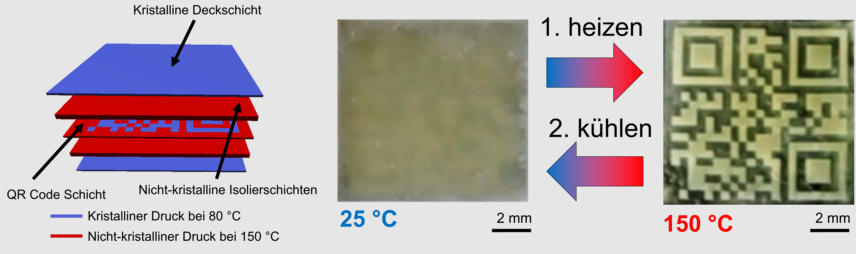
The layer system of the “invisible” QR-code. Image via TU Wien.
Demonstrating Practical Applications
The team demonstrated the flexibility of their method with several examples. In one, they produced a plastic object containing an invisible QR code hidden beneath a crystalline layer. When heated to a specific temperature, the crystalline layer becomes transparent and the QR code is revealed. As the material cools, the layer returns to its original state, once again hiding the code.
The same principle was used to print a warning symbol that appears only when the temperature rises beyond a certain limit, offering a possible tool for monitoring heat-sensitive goods. Optical characterization of the materials was carried out in collaboration with Professor Andrei Pimenov’s research group at TU Wien’s Institute of Solid State Physics.
“We are offering a completely new range of possibilities for 3D printing,” says Ehrmann. “Potential applications can be envisaged in many different areas, from data storage and security to biomedical applications.”
Light-Based Methods in 3D Printing
TU Wien’s technique is part of a broader trend in light-based 3D printing methods that aim to enhance material control and improve printing precision.
For instance, Massachusetts Institute of Technology (MIT) researchers recently developed a 3D printing method that uses a light-sensitive resin capable of forming both durable structures and dissolvable supports—depending on the type of light it’s exposed to. Ultraviolet (UV) light hardens the resin into strong, permanent shapes, while visible light produces weaker supports that can be dissolved in specific solvents. The new method eliminates manual post-processing such as cutting or filing, accelerating production and minimizing waste.
In 2020, a research team at the University of Texas at Austin developed a photopolymer resin designed to speed up high-resolution curing with visible light. The panchromatic material cures under four wavelengths—violet, blue, green, and red—and consists of a monomer, a photoredox catalyst, two co-initiators, and an opaquing agent. The researchers noted that the resin can be combined with various additives, including biological compounds, enabling applications in tissue engineering and medical device fabrication.