Date:2025-12-02 10:10:44
Researchers at NEST, Scuola Normale Superiore, and the University of Pisa have developed 3D-printable photochromic polymers capable of performing arithmetic and logic operations using only light. The study, published in Light: Science & Applications, demonstrates that these materials can control transmitted light intensity and spatial patterns with precision, supporting the development of all-optical computing and long-term information storage systems.
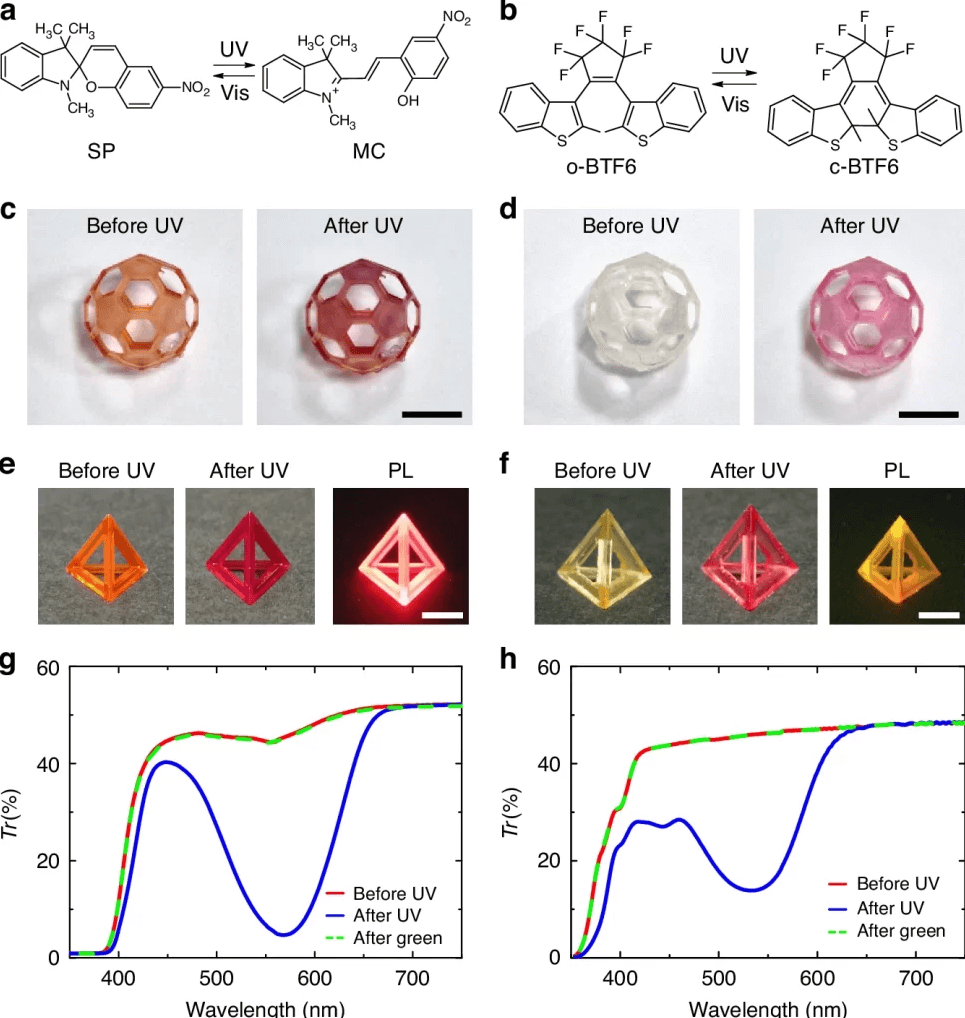
The team fabricated the materials using bisphenol A ethoxylate dimethacrylate (BEDMA), a transparent, UV-curable matrix selected for its stability and clarity in the visible range. Diphenyl(2,4,6-trimethylbenzoyl) phosphine oxide (TPO) was employed as a photoinitiator. Two photochromic molecular systems were incorporated into the matrix: a spiropyran compound, 1′,3′-dihydro-1′,3′,3′-trimethyl-6-nitrospiro[2H-1-benzopyran-2,2′-(2H)-indole] (SP), and a diarylethene derivative, 1,2-bis(2-methyl-1-benzothiophene-3-yl) perfluorocyclopentene (BTF6). Both reversibly switch between colorless and colored states when exposed to ultraviolet (UV) and green light, respectively, modifying the optical transmission of the printed structures.
Samples were produced by digital light processing (DLP) 3D printing, yielding geometrically uniform objects that preserved optical transparency and fluorescence. The UV-induced colored forms exhibited absorption peaks at 565 nanometers for SP and 535 nanometers for BTF6, while fluorescence emissions appeared at 654 nanometers for the merocyanine (MC) form of SP and 617 nanometers for the closed form of BTF6. Repeated switching between the two states remained stable after 102 UV/green exposure cycles. SP-based devices retained approximately 70 percent of their initial transmission contrast, and BTF6-printed samples maintained 85 percent, showing improved fatigue resistance compared to similar systems in other polymer matrices. BTF6 devices also preserved their optical characteristics after twelve months in dark storage, confirming long-term photochemical stability.
Researchers demonstrated that spatially selective illumination could dynamically reconfigure light propagation within the 3D printed materials. When specific areas were exposed through shadow masks, regions of color change could be written, erased, and rewritten using alternating UV and green light. This method enabled real-time modulation of optical attenuation across the printed slabs.
A probe beam at 617 nanometers revealed that transmitted intensity depended on both UV exposure time and the length of the illuminated region. These parameters controlled the dynamic optical loss coefficient (αd), which varied over one order of magnitude depending on the exposure conditions. By fine-tuning these factors, the printed photochromic materials functioned as optically reconfigurable filters, capable of encoding, storing, and erasing information with sub-millimeter precision.
Arithmetic and Logic Operations With Light
The SP-based devices were used to perform all-optical arithmetic operations. Each UV pulse represented an incremental step that gradually converted the polymer from a transparent to a colored state, reducing transmitted light intensity. Once a threshold level was reached, a green pulse reset the device to its original colorless form. Using this process, the researchers carried out calculations such as “5 + 7 = 12,” where the number of UV pulses corresponded to the addends and the reset events indicated carryover operations. A similar sequence of pulses enabled division, as demonstrated in “20 ÷ 6,” where the number of resets and residual light levels represented the quotient and remainder.
Two interconnected photochromic devices extended this concept to multi-digit operations. The first unit performed arithmetic sequences, while the second counted the number of green reset pulses, functioning similarly to the parallel rows of an abacus. The system provided tens and units outputs through discrete optical levels.
Logic functions were implemented using the same molecular systems. Individual devices acted as NOT gates, producing a transmitted “1” output when UV input was absent and a “0” when illuminated. Two devices arranged in series formed NOR gates, where the output intensity depended on combined UV inputs. Arrays of spiral-shaped 3D printed components, each containing twelve SP/MC computing units, demonstrated scalable and addressable architectures for parallel optical processing.
Toward All-Organic Optical Computing Platforms
The energy required to reach the computational threshold in these devices ranged from 10 to 30 millijoules per square centimeter—approximately one order of magnitude lower than similar operations achieved with inorganic phase-change materials. The combination of reversible photochromic switching, stability, and 3D printable fabrication enables compact organic processors that use light as both input and control signal.
According to the authors, further optimization of additive manufacturing could improve dopant dispersion and allow integration of multiple optical elements within single printed structures. These findings open a route toward scalable, low-energy optical circuits that integrate sensing, computation, and memory in a single material system. Beyond computing, the same materials could be adapted for adaptive optics, data storage, and photonic sensing applications.