Date:2025-12-22 10:11:40
According to Chalmers University of Technology, as the gas turbine industry moves toward hydrogen-fueled systems, components must withstand even higher temperatures. Additive manufacturing enables smarter designs to meet these demands, but printing high-performance metals is still challenging. Ahmed Fardan Jabir Hussain, Doctoral Student at Chalmers University of Technology, is tackling this challenge to make 3D printing viable for the toughest applications.
When it comes to high-performance metals, the process of printing is complex. One such metal is CM247LC, which is exceptionally durable and well-suited for applications in extreme environments, but also one of the hardest metals to process with 3D printing.
“The superalloy is often called ‘the Holy Grail’ of metal additive manufacturing. If we can process it successfully, it could enable higher operating temperatures and improve efficiency of industrial gas turbines,” said Ahmed Fardan Jabir Hussain.
The alloy tends to crack either during printing or in post-processing heat treatment and has limited resistance to deformation under long-term high temperatures (known as creep) compared with cast components – issues that make it unsuitable for industrial use in its current printed form.
Process optimization
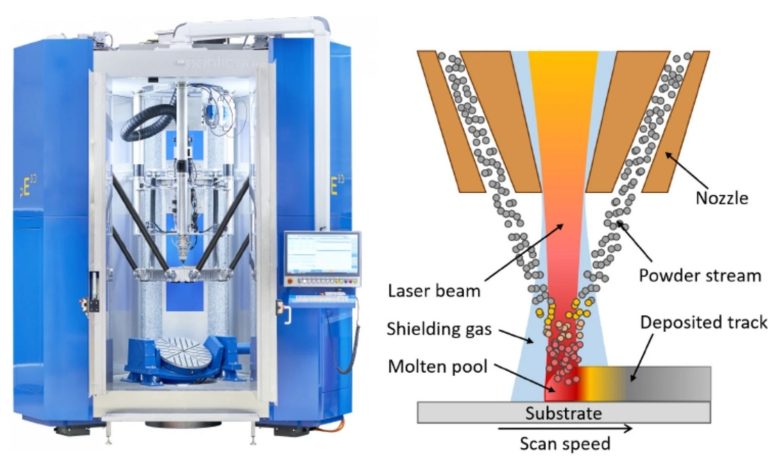
Rather than altering the alloy itself, Fardan focused on getting the most out of the existing standard composition. By fine-tuning laser power, scanning strategies, and heat treatments, he reduced cracking and significantly improved durability. These efforts resulted in nearly crack-free samples in simple geometries such as cubes; however, the cracking during post-processing heat treatment in complex geometries remains. Additionally, his research also indicates how to print and heat treat CM247LC to improve creep performance.
“One of the biggest lessons through this work is that you can’t just fix one problem in isolation. If you reduce micro-cracking too much, you might worsen macro-cracking or creep performance. A holistic approach is essential. That’s where collaboration with industry really helps,” he said.
Industrial benefits
Throughout his PhD, Fardan collaborated closely with Siemens Energy. “Fardan’s research has given us valuable insights into how to process these challenging materials. We’re already applying the learnings to develop new alloys and improve our additive manufacturing processes,” said Håkan Brodin, Materials Technology Expert at Siemens Energy. “We’ve reached the limits with traditional materials and cooling strategies. To go further, we need better materials and processes, and this research helps us do exactly that.”
The ability to reliably print high-temperature turbine components could transform energy production by enabling higher efficiency, reduced emissions, and more flexible supply chains, but the methods and insights from this research also have wider applications.
“Even if this material in particular remains difficult, the lessons we’ve learned can definitely be applied to other superalloys and help advance additive manufacturing as a whole,” said Ahmed Fardan Jabir Hussain.