Date:2026-03-23 09:18:10
Researchers at Rutgers University have developed a digital twin-based framework designed to keep additive manufacturing operations running continuously during cyberattacks, rather than shutting down production while security gaps are patched.
Rajiv Malhotra, Associate Professor in the Rutgers School of Engineering Department of Mechanical and Aerospace Engineering, led the research alongside a team of Rutgers students and external collaborators.
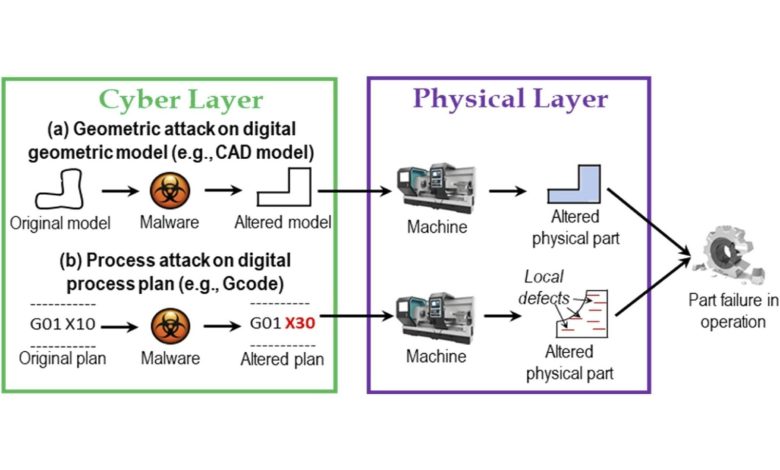
Modern manufacturing’s reliance on digitalization and connectivity has led to weaknesses that expose production systems to malware. This can result in the compromise of additive manufacturing parts through geometry alterations or the insertion of small, difficult-to-detect local defects.
Such attacks on the production of electronics, spacecraft, biomedical devices, and automobiles can carry broad implications for economic stability and national security.
“Traditional approaches for addressing the threat of cyberattacks rely on reporting and detecting the issue and shutting production down, while plugging the gaps in the cyber layer before production starts again, which can take weeks with no guarantees that the next attack won’t exploit some other gap in the cyber layer,” explained Malhotra.
The proposed system deploys geometric and process digital twins — virtual replicas of physical manufacturing processes — working together at key vulnerability points across the manufacturing digital chain, including part models, machine firmware, and process plan generation software.
The framework enables rapid repair of attacked digital geometries without repeated fabrication-printing-correction cycles, and disrupts the formation of local defects even when the nature of an attack is not explicitly known. “This scalability to unknown attacks is critical,” Malhotra said.
The research also addressed scalability constraints related to materials, cost, and supply chain that had previously limited resilience efforts in the sector.
Commercialization and expanded scope
Malhotra and the team are currently working with industry partners to commercialize the framework for deployment in manufacturing facilities. Future research will extend to attacks on sensor signals, machine and human safety, and hybrid manufacturing systems.
“We are also expanding this approach towards expeditionary manufacturing for defense and space applications — and are also very interested in collaborating with other industry partners beyond our current scope,” Malhotra added.
The findings were published in the Journal of Manufacturing Systems.