Date:2026-03-31 10:32:13
Researchers from the Czech Technical University in Prague and Ponticon have tested the mechanical and fracture performance of Inconel 718 deposited by high-speed laser-based directed energy deposition (HS DED-LB), in the first systematic characterization of HS DED-LB Inconel 718 under varied process conditions.
The Inconel 718 blocks
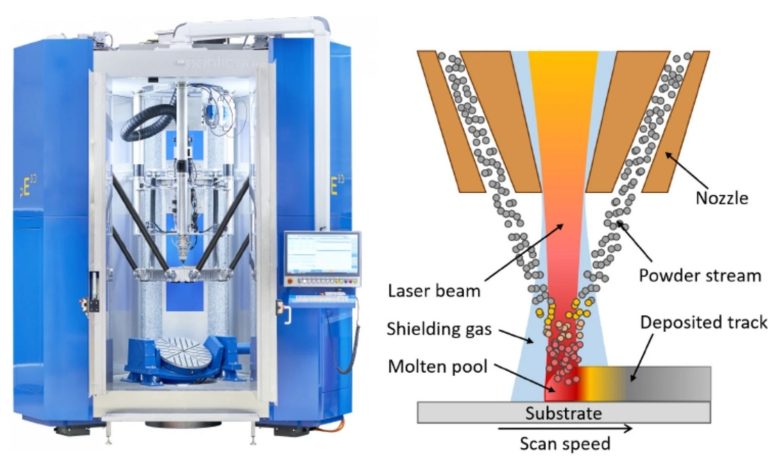
The study, published in the Journal of Thermal Spray Technology, undertook a process variant that combines high-speed kinematics with a high-power infrared laser to achieve deposition rates suited to large industrial components. Inconel is a popular “superalloy,” frequently used in AM for applications that need to withstand extreme conditions such as temperatures of 700ºC (close to 1,300ºF).
Deposition was carried out using a pE3D system from Ponticon, capable of linear speeds up to 200 m/min with an 8,400 W diode laser. Nine Inconel 718 blocks were produced at laser power levels of 1,800, 2,100, and 2,400 W and scanning speeds of 40, 50, and 60 m/min. This yielded linear energy densities between 1.8 and 3.6 kJ/m — values that fall between those typical of powder bed fusion (PBF-LB) and conventional directed energy deposition (DED-LB), and which are therefore rarely observed.
Powder feed rate was held at 30 g/min, approximately one order of magnitude above conventional DED-LB rates, and no post-print heat treatment was applied.
Property stability and fracture performance
Despite significant changes in laser power and scanning speed, a stable process window was indicated – across all nine parameter combinations, mechanical and fracture properties varied by less than 10%.
Fracture toughness values of approximately 100 MPa√m were consistent with as-built DED-LB and PBF-LB results from prior literature, although fatigue crack growth resistance was lower than wrought reference material which was an expected outcome, given the absence of precipitation hardening.
Microstructural analysis showed that texture shifted from a cube configuration at lower scanning speeds to a fiber texture at higher speeds, with solidification crack density increasing alongside porosity at the highest scanning speed tested (which was 0.41–0.46%).
The study’s conclusion noted that follow-on work would evaluate the effect of post-print heat treatment on HS DED-LB Inconel 718, in a bid to target property levels comparable to directionally solidified materials.