Date:2026-04-20 09:12:13
Researchers from Lawrence Livermore National Laboratory (LLNL), Imperial College London, and collaborators have built and tested AI-optimized targets that suppress the Richtmyer-Meshkov instability (RMI) — a shock-driven phenomenon that degrades performance in inertial confinement fusion (ICF) experiments.
The work, published in Physical Review Letters, represents one of the first demonstrations that structures generated by a machine-learning design algorithm could be physically fabricated and experimentally validated.
RMI occurs when a shock wave crosses an interface between materials of differing densities. This produces unstable jetting that can disrupt the symmetry of an imploding fusion capsule and reduce energy yield.
The research team’s approach used a machine-learning optimization algorithm to search through candidate void geometries — specifically shaped cavities within the target material — capable of redistributing a shock wave before it reached the unstable interface.
“Our target reshapes the shockwave, in both space and time, as it travels through the material,” stated first author Jergus Strucka, now at the European XFEL. “Instead of a single shock hitting the surface, we introduce voids to break it up into a sequence of smaller pressure pulses that arrive at slightly different times.”
How the target was built and tested
To fabricate the targets, the team used a polymer 3D printer to produce an inverted mold of the desired structure. Gelatin was cast into the mold, allowed to set, and removed — producing a sample with a wavy surface on one side and the optimized void geometry on the other.
3D printed gelatin targets suppress shock instabilities that threaten fusion experiments
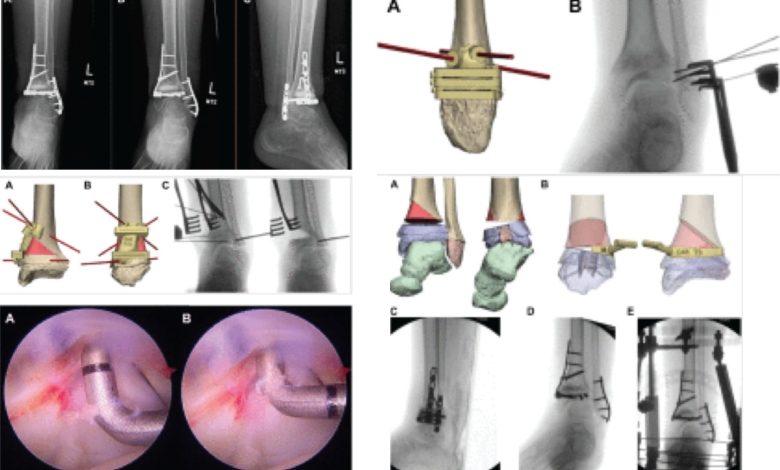
The green dashed lines highlight void structures, while red lines show tracked interfaces.
The gelatin target was then placed on a thin copper strip, through which a large electrical pulse — described by the researchers as equivalent to several lightning strikes — was discharged. The copper heated, exploded, and launched a shock wave into the gelatin. The wave first encountered the voids, which reshaped and redistributed it before it reached the wavy interface where RMI would otherwise develop.
“To some degree, we are creating another instability using the designed voids that acts against the RM instability and reduces jetting,” said Dane Sterbentz, a scientist at LLNL and study co-author.
“By modifying the original pressure pulse as it passes through these voids, we are also creating a sort of secondary pressure wave that can actually act against the unstable jetting.”
Strucka added: “The challenge is that while these designs look promising in simulations, they are often extremely difficult to manufacture and experimentally test. Our work is one of the first demonstrations that such AI-optimized structures can actually be built and studied in real experiments.
Path toward fusion and broader applications
Because the underlying void physics should apply equally in spherical geometries, the researchers stated the results could inform the design of fill tubes and material interfaces in ICF capsules to help isolate individual effects, rather than replicating full ICF conditions.
“For ICF experiments at the National Ignition Facility (NIF), it can be difficult and costly to probe isolated effects like the RM instability,” said Sterbentz. “That’s where our experimental setup is useful — it allows us to probe the instability in a much simpler system. However, experiments more directly relevant to ICF will have to be further pursued at facilities such as the Omega Laser Facility or NIF.”